82.1K
Downloads
494
Episodes
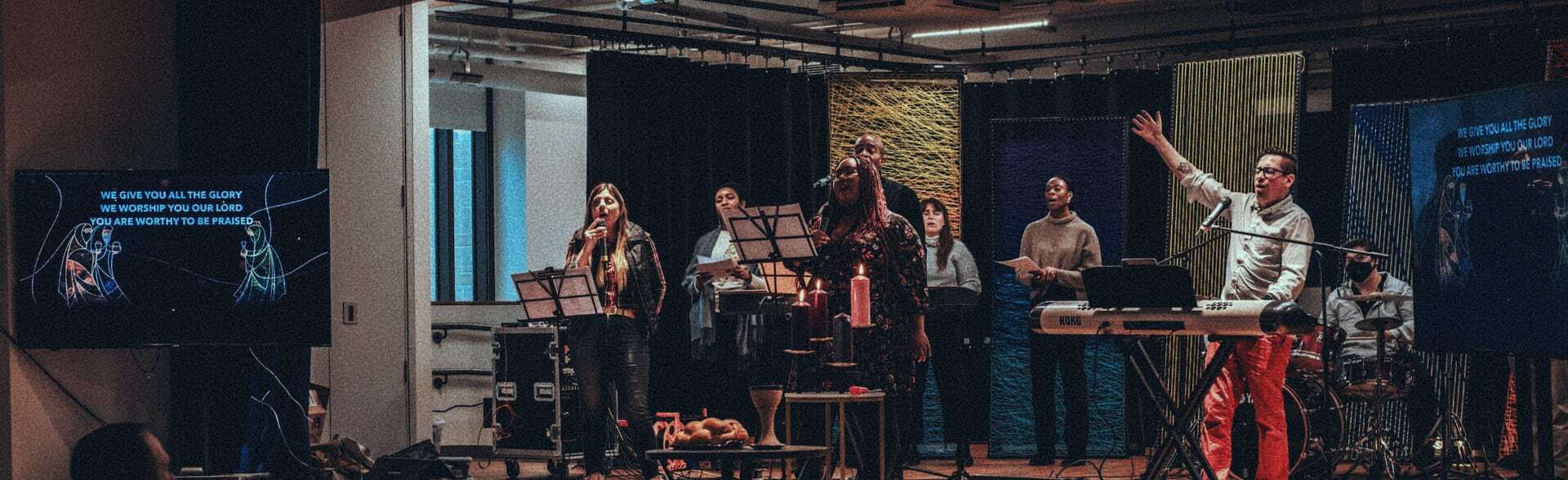
The Table Church’s vision is embody a more beautiful gospel that announces collective liberation and the renewal of all things. We are a multiracial, LGBTQ affirming church in Washington, DC.
Episodes
3 hours ago
3 hours ago
32 min
Food offered to idols sounds like the least urgent question in the Bible. In Corinth it was a question about money: meat was expensive, and most of it was served at banquets in wealthy homes and the city's temples, where the church's richer members kept up their social standing. Continuing Hot Takes in 1 Corinthians 8, Matt reads Paul's answer to the members who had reasoned their way to "an idol is nothing at all." He sets their gnosis, the knowledge that puffs up, beside the syneidesis, the conscience, of poorer and newer believers. He weighs why Paul cared so much, from a theology built to protect a comfortable life to temples that were places of harm, and tells why The Table stopped serving wine at communion. Paul's hot take: love and care for the vulnerable win out over knowledge. How do we make sure our freedom doesn't harm someone else?

Oct 18, 2026
Oct 18, 2026
48 min
Content note: this sermon discusses sex, consent, coercion and abuse in relationships, and church teaching about sexuality that has harmed people. "The wife does not have authority over her own body, but the husband does." Plenty of us heard that half of 1 Corinthians 7:4 used as a weapon. Paul keeps going: "Likewise the husband does not have authority over his own body, but the wife does." In Corinth, that second half was almost unheard of. Closing a three-week Hot Takes trilogy on 1 Corinthians 5–7, Pastor Anthony reads chapter 7 by theme and lays three foundation stones for relationships after purity culture: mutuality, peace, and covenant. He looks at why Paul grades his own advice five times, how Roman law let married men off the hook, how church law turned a mutual gift into a debt men collected, why leaving abuse is not sin, why celibacy is a gift and never a sentence, and what to say to people who are single and don't want to be. The sermon draws on Rev. Tonetta Landis-Aina's Affirmation Guide for Sexuality & Spirituality and its nine criteria for faithful relationships. Love runs both ways, and God calls us to peace. The only thing we owe one another is love. If this sermon touches your story: National Domestic Violence Hotline: 1-800-799-7233, or text START to 88788 DC Victim Hotline, 24/7: 1-844-443-5732 DC Rape Crisis Center, 24/7: (202) 333-7273 RAINN, 24/7: 800-656-4673 988 Suicide & Crisis Lifeline: call or text 988 To report misconduct at The Table Church, use the link at the bottom of thetablechurch.org. Reports go to all the elders at once, bypassing Pastors Anthony and Tonetta.
Oct 11, 2026
Oct 11, 2026
46 min
Content note: this sermon discusses sexual harm, sex work, and a Bible verse that has been used against LGBTQ people. Purity culture taught that bodies matter because they can be ruined. In 1 Corinthians 6, Paul says bodies matter because God raises them, lives in them, and has bought them. Pastor Anthony walks through the whole chapter: siblings with money dragging each other into court, a list of the unjust that ends with "this is what some of y'all used to be," and men who think they can buy a body. Along the way he looks at how the word "homosexual" first entered an English Bible in 1946, what the Greek words malakoi and arsenokoitai can and can't tell us, and why Paul confronts the buyer and never blames the woman. The market says everybody has a price. God walked into the market too, and what God has bought, nobody else gets to own. Part two of a two-part Hot Takes conversation on 1 Corinthians 5 and 6. If this sermon touches your story: DC Rape Crisis Center, 24/7: (202) 333-7273 The Trevor Project: 1-866-488-7386, or text START to 678-678 988 Suicide & Crisis Lifeline: call or text 988 To report misconduct at The Table Church, use the link at the bottom of thetablechurch.org. Reports go to all the elders at once, bypassing Pastors Anthony and Tonetta.
Oct 7, 2026
Oct 7, 2026
29 min
Content note: this episode includes frank discussion of sexual harm.
Churches have a reputation for policing everyone else's behavior while ignoring the harm happening inside their own walls. In 1 Corinthians 5, Paul confronts a community that looked the other way while a well-connected man exploited a woman who never gets a voice in the story. Then he asks a surprising question: what business do we have judging outsiders at all?
Pastor Anthony unpacks what the word usually translated "sexual immorality" actually meant. Hint: it's about exploitation and power, not a list of rules. He also explores why Paul's first instruction was to grieve, and how he reworked an ancient punishment toward accountability and restoration rather than revenge.
This is part one of a two-part conversation in our Hot Takes series
Sep 27, 2026
Sep 27, 2026
27 min
We live in an image-is-everything world. Influencers coach us on how to speak, how to present, and how to pitch ourselves to get ahead. Even in communities that prize curiosity and good questions, it's easy to trade the search for truth for the comfort of airtight answers.
In this week of Hot Takes, our series on 1 Corinthians, Pastor Tonetta Landis-Aina takes on a letter many of us have complicated feelings about. She draws on The Great Gatsby, a mocking piece of ancient Roman graffiti, and the wisdom of Howard Thurman's grandmother. Along the way she explores why the people the world overlooks are often the ones best equipped to teach us, and why excellent answers can't get us to excellent love.
Listen for permission to stop performing, and share it with someone who's tired of trying to be what everyone else wants.
Sep 24, 2026
Sep 24, 2026
27 min
Remember group projects? There was the partner who vanished, the one who did all the work, and the crush that made everything complicated. Community can feel the same way: a room full of people you didn't pick and can't control. So what do you do when belonging gets messy?
Kicking off our fall series Hot Takes, Tonetta opens Paul's first letter to the church in Corinth. That was a small, status-conscious community already at odds with itself. Before Paul corrects anyone, he says thank you. This message explores why grace and gratitude, not flawless performance, are what actually hold people together. It also shares how two frustrating grad school partners turned into some of life's most unexpected gifts.
Listen if you've ever wanted to quit a group, or a church. Then ask yourself: who's someone you need to thank this week?
Sep 17, 2026
Sep 17, 2026
16 min
Ever had a big, dramatic moment — a decision, a promise, a "this changes everything" instant — that didn't actually change much? Pastor Tonetta opens with a story about the most intense altar call of her life, and what her body remembers isn't the music, it's the fear of being surrounded and pressured to prove she'd "been saved."
From there, she asks a harder question: what if real commitment was never supposed to be one moment at all? Drawing on two odd parables about a half-built tower and a losing war, she unpacks why skipping the cost of change sets people up to fail — and why walking away from manipulative, high-control tactics isn't rebellion, it's clarity.
If you've ever been burned by pressure-tactic religion, or you're just skeptical of anything sold as instantly life-changing, this one's for you.
Sep 2, 2026
Sep 2, 2026
14 min
Every community has a guest list — and every guest list has an unspoken logic about who makes the cut. Tochi digs into why we default to inviting people who already look, think, and live like us, and what gets lost when we do.
Using Encanto's "We don't talk about Bruno" and Janelle Monáe's Dirty Computer as entry points, Tochi traces a throughline: families, institutions, and even religious spaces have a habit of erasing whoever makes them uncomfortable. Then he turns to a 2,000-year-old story Jesus told about a dinner party that gets radically reorganized — not around status, but around who's been left out. The question underneath it all: what would it take to actually widen the circle, instead of just saying we want to?
If you've ever felt like the "difficult" one in a room, this one's for you.